As we all know, feedback is a vital part of the Remote Viewing process. We need something against which we can validate the data gathered and assess its accuracy.
BUT… what happens when the feedback itself is disputed?
And perhaps more importantly: how much does our own worldview influence which feedback we choose to accept?
A few months back, Sacha posted in my private RV facebook group about the Tic Tac UAP events, arguing that those involved had lied and that the object was actually conventional technology constructed from aerogel.
At the time, I strongly argued against this interpretation because I felt the testimony and evidence from trained, informed people directly involved in the events pointed elsewhere.
This week, I watched a fascinating interview with Rear Admiral Tim Gallaudet (ret.), former acting administrator of NOAA and former Oceanographer of the Navy.
Speaking about encountering the GoFast material while serving, he makes the point that he knew advanced US technology would not be tested in the middle of a compressed Navy training exercise, that dedicated test ranges existed for that purpose, and that his security clearance gave him knowledge of relevant foreign threats. His conclusion was that what he encountered did not fit either explanation.
Whatever you think about the Tic Tac events, this raises an interesting problem for Remote Viewing: what exactly constitutes valid feedback?
As humans, we naturally tend to give greater weight to evidence that supports our existing model of reality. One person accepts testimony from military witnesses as strong feedback; another accepts an alternative technological explanation as stronger feedback.
Both may then score exactly the same Remote Viewing data against completely different versions of “reality.”
I’m not suggesting that all competing feedback can be correct. Obviously, contradictory explanations cannot all describe the same event accurately.
My point is that multiple competing sets of feedback can exist simultaneously — while the objective truth remains unknown.
And that matters enormously in Remote Viewing.
The viewer, the tasker, the feedback, our interpretation of that feedback, and perhaps the wider phenomenon itself are not necessarily static or independent components. They form a much more dynamic and potentially symbiotic system than we sometimes acknowledge.
So perhaps we should occasionally ask ourselves:
Are we scoring the Remote Viewing against reality — or against the version of reality we currently believe to be true?
Something to think about and debate.
LINKS:
==========================================
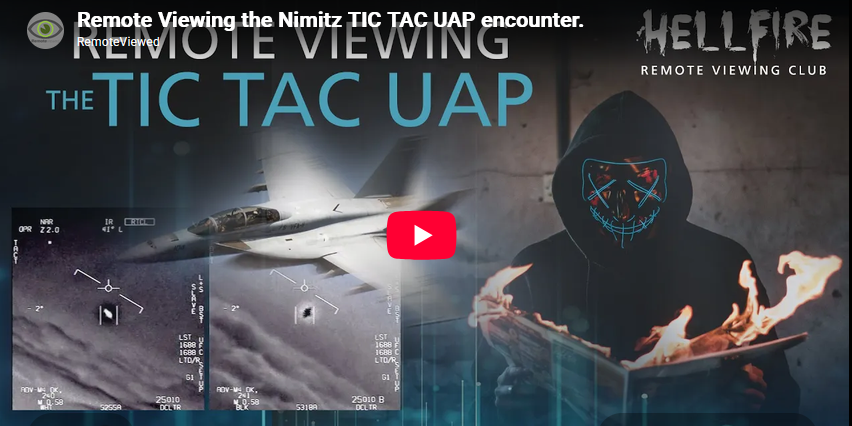
For anyone interested, here is my Hellfire Club Remote Viewing project on the Tic Tac events:
Rear Admiral Tim Gallaudet interview: Top Navy Admiral: “The Ocean is FULL OF UFOs!”
Sacha’s alternative feedback/interview: TicTac was a Lie